The Use of Artificial Intelligence in Medicine

Artificial intelligence in medicine is currently transforming the healthcare industry, opening up new opportunities for healthcare business owners. According to MarketsandMarkets, the global healthcare AI market, valued at $14.92 billion in 2024, reached $21.66 billion in 2025 and is projected to grow at a compound annual growth rate (CAGR) of 38.6%. Analysts predict that by 2030, the market will reach $110.61 billion, driven by the growing need for early detection of chronic diseases and personalized treatment. This article will be useful for healthcare facility executives seeking to modernize their businesses using innovative technologies.
How AI Is Used in Medicine

The healthcare industry has become one of the main areas for the practical implementation of artificial intelligence technologies. AI is actively used in various fields:
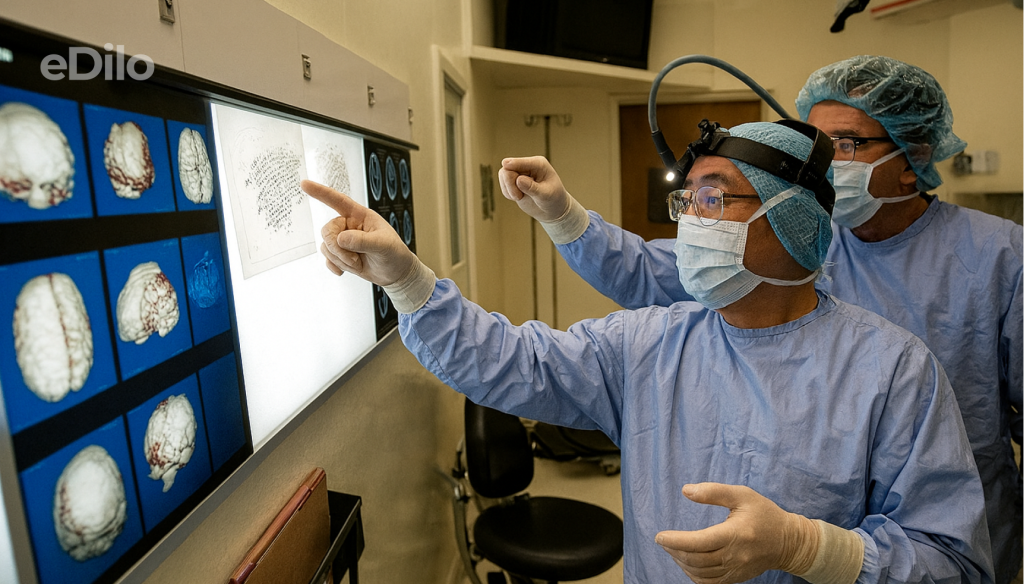
- Medical image processing and analysis — machine learning algorithms analyze CT, MRI, X-ray, and ultrasound images with incredible speed and accuracy, detecting signs of cancer, pneumonia, tuberculosis, and other diseases;
- personalized treatment — AI helps develop individualized treatment plans based on a patient’s genetic information, medical history, and lifestyle, selecting the optimal dosages for medications or radiation therapy;
- medical research — machine learning tools process vast amounts of data to identify patterns and develop new treatment methods;
- epidemic forecasting and modeling — AI algorithms create comprehensive simulations of the spread of infectious diseases to develop effective response strategies;
- Drug discovery — artificial intelligence analyzes millions of chemical compounds to identify potentially promising molecules for drugs, significantly reducing development time and costs;
- genomic data analysis — specialized neural networks process information to identify genetic markers of diseases and select optimal treatment methods;
- Predictive maintenance of medical equipment—AI algorithms monitor the operation of complex equipment, predicting potential breakdowns and preventing downtime;
- Management — Artificial intelligence systems help predict a facility’s workload, optimize staff schedules, and allocate resources.
Our online service eDilo helps implement artificial intelligence in medicine, providing financial flexibility when purchasing high-cost equipment with AI capabilities. Paying in installments allows you to get everything you need today while spreading the financial burden across your business.
The Benefits of Using AI in Medicine
Let’s take a look at the key benefits that open up new opportunities for the development of healthcare facilities:
- Improving diagnostic accuracy—artificial intelligence in medicine analyzes vast amounts of data, identifying trends and patterns that may be invisible to the human eye. AI algorithms can detect cancerous growths in the early stages with up to 95% accuracy, which significantly increases the chances of successful treatment;
- Workflow Optimization — AI automates routine tasks, such as filling out paperwork and analyzing test results, allowing medical staff to focus on communicating with patients. This increases the clinic’s efficiency by 30–40% and reduces operating costs;
- Personalized treatment—machine learning algorithms develop individualized treatment plans based on each patient’s unique characteristics, which increases effectiveness by 25–30% and reduces the risk of side effects;
- Cost reduction — according to research, the implementation of AI solutions in a healthcare facility can reduce administrative expenses by 15–20% and lower the cost of diagnostic procedures by 10–15%;
- Accelerating scientific research—artificial intelligence analyzes clinical trial data 5–10 times faster than traditional methods, which speeds up the development of new treatments and medical technologies;
- Improved Experience — AI assistants provide round-the-clock support, answer questions, and send medication reminders, which increases patient satisfaction by 40% and boosts customer retention rates;
- Preventive medicine—predictive algorithms identify disease risks before symptoms appear, allowing for the implementation of early preventive measures and a reduction in overall treatment costs.
These advantages make AI not just a technological trend, but an essential tool for healthcare facilities seeking to improve the quality of their services, optimize costs, and remain competitive in the market.
Challenges in the Use of Artificial Intelligence in the Medical Field
One of the biggest challenges in using artificial intelligence in medicine is protecting patients’ personal data. AI systems process large volumes of confidential medical information, which poses risks to privacy. In accordance with the General Data Protection Regulation (GDPR) and Ukrainian law, healthcare facilities must ensure the security and confidentiality of this data.
Maksym Voinov, a lawyer at the Center for Strategic Affairs of the Ukrainian Helsinki Human Rights Union, notes: “The use of AI poses several particularly significant challenges to the realization of the human right to privacy and creates a need to develop additional regulations on data protection.”
According to the Fundamentals of Ukrainian Legislation on Health Care: “Access to patient information contained in the electronic healthcare system is permitted only upon obtaining the consent of the patient (or their legal representative) in writing or in a form that allows for the conclusion that consent has been given.”
Another major challenge is the issue of AI errors. Who is liable if an algorithm makes an incorrect diagnosis—the system developer, the medical facility, or the doctor? This issue requires clear legislative regulation.
In Ukraine, the “Concept for the Development of Artificial Intelligence in Ukraine” was approved by a resolution of the Cabinet of Ministers in December 2020; it identifies the development of AI technologies as one of the priority areas in the field of scientific and technological research. However, this is not sufficient for comprehensive regulation of the industry.
Ukraine is also considering Bill No. 8153, “On the Protection of Personal Data,” which aims to bring Ukrainian legislation into line with international standards. It specifies the principles governing the processing of personal data and establishes financial liability for violations of the right to personal data protection.
The Future of Artificial Intelligence in Ukrainian Medicine
There are already successful examples of AI implementation in medical practice in Ukraine. In particular, medical facilities in Ivano-Frankivsk are actively using artificial intelligence to process images obtained from ultrasound and CT scans. AI is also used to diagnose tuberculosis, where the technology analyzes lung images to detect abnormalities with high accuracy.
Over the next 5–10 years, we can expect to see development in the following areas:
- Medical chatbots for consultations—automated systems that will provide basic information, especially in regions with limited access to medical services;
- robotic surgery — the development of robotic systems for performing complex surgeries with high precision and minimal invasiveness;
- regenerative medicine — the use of AI in developing methods for creating artificial organs and tissues for transplantation;
- Neural interfaces — the development of “brain-computer” systems that will help patients with mobility, hearing, and vision impairments.
Our service eDilo We are ready to support Ukrainian healthcare facilities on their path to modernization by offering installment payment plans for the implementation of innovative technologies. We understand that investments in AI can be significant, so we offer a solution that allows you to spread out the financial burden and start reaping the benefits of new technologies today.
The adoption of artificial intelligence is not just a trend, but a prerequisite for the future competitiveness of the healthcare industry. With eDilo, this path becomes more accessible and convenient for every healthcare facility in Ukraine.
FAQ
What specific financial return (ROI) can we expect from investing in AI solutions?
The implementation of AI solutions in a healthcare facility delivers an ROI of 120–200% over 3–5 years by reducing administrative costs by 15–20%, a 30–40% reduction in diagnostic time, a 15–25% increase in diagnostic accuracy, and a 15–25% increase in the facility’s throughput. Investments in AI for medical image analysis can pay for themselves in as little as 18–24 months.
Which fields of medicine are currently best positioned for the successful implementation of AI technologies?
The fields most ready for implementation are: radiology (90–95% accuracy in analyzing X-rays, CT scans, and MRIs), dermatology (diagnosis of skin diseases with up to 87% accuracy), cardiology (ECG analysis with 85% accuracy), and clinic management (reducing patient wait times by 30%). In laboratory diagnostics, AI increases the accuracy of tests by 15–20%.
How can AI improve access to healthcare for patients in remote areas?
AI improves accessibility through telemedicine platforms featuring virtual assistants for 24/7 initial screening and basic consultations. Local analysis of medical images eliminates the need for transport to specialized centers. AI-powered mobile apps allow for the monitoring of chronic conditions at home, while voice assistants provide access to medical information for people with disabilities.
What are the key steps required for the successful implementation of AI solutions in medical practice?
Key steps:
- Conduct a process audit and identify problem areas.
- Establish clear goals and KPIs;
- Select a certified AI solution that is compatible with existing systems;
- Ensure compliance with data protection laws;
- Train staff to work with new technologies;
- Start with a pilot project before full implementation.



More about business
and finance
Read more

Which Chinese Tractor Is the Best to Buy: Top 5 Models

Solar Panel Business: How to Set It Up and Calculate Liquidity

How to Choose a Business Idea in 2026: Top Ideas for Ukraine

Military Tax in Ukraine in 2025

A $5,000 Business in 2026: How to Start a Business with Minimal Risk

How to Prepare Your Business for Black Friday 2026: Purchasing Without Straining Working Capital

How to Prepare Your Business for the Fourth Quarter: A Financial Checklist for Executives

How to Avoid Stalling Business Growth Due to Large Supplier Invoices

How Businesses Can Prepare for the Peak Sales Season in Fall and Winter