UGC Content: What It Is and How to Work With It

UGC content is a powerful marketing tool in the age of social media. Created directly by users and consumers, this format has proven to be an effective way to strengthen the connection between brands and their audience. Today’s companies actively encourage customers to share their experiences, photos, and reviews of products or services. This strategy not only saves resources on content creation but also builds trust in the brand among potential users.
What Is UGC Content?
The UGC model refers to any posts created by users, rather than by a company or brand. Photos, videos, reviews, comments, and social media posts—all of these are forms of user-generated content that may relate to products, services, or the brand as a whole.
What makes UGC unique is that it is generated by ordinary people who do not work for the company and do not receive direct compensation for it. Such content is considered more authentic and inspires greater trust among potential customers, as it reflects real-life experiences with the product or service.
The main goal of UGC content is to engage the community in creating posts that the brand can then use for marketing purposes. This model often involves encouraging users to share their stories, reviews, and photos on social media using branded hashtags or through special contests and promotions.
The Benefits of UGC for Businesses
The main benefits for brands that skillfully incorporate UGC into their marketing strategy are:
- Increased trust — people are more likely to heed recommendations from other users than direct advertising from a brand;
- Increased engagement — UGC encourages the audience to interact with the brand and create their own content;
- resource savings — users create posts for free or for a nominal fee;
- Authenticity — UGC reflects the genuine experience of using the product;
- Increased organic reach—user-generated content is often shared through their social media accounts;
- SEO benefits — more posts with relevant keywords improve search engine rankings;
- Diversity — users create various types of content, which enriches the marketing strategy.
According to Deloitte’s “Digital Media Trends” study, published in the Wall Street Journal, half of American respondents admit that they spend more time watching UGC than they originally planned (among Gen Zers, this figure reaches 70%). About 4 in 10 Americans prefer watching user-generated video content to TV shows and movies on streaming services, and among Zoomers and Millennials, this figure rises to 60%. It is also important to note that 70% of respondents follow influencers, and one-third admit that these online personalities influence their purchasing decisions (for younger generations, this influence exceeds 50%).
See also: Sales Scripts: Benefits for Businesses
Does Your Brand Need User-Generated Content?
Understanding what UGC content is and actively using it is particularly effective for brands operating in the B2C segment, such as in the following areas:
- fashion;
- beauty;
- food;
- travel;
- technologies.
These industries are visually appealing and naturally encourage consumers to share their experiences. Companies that sell products or services that evoke an emotional response or have aesthetic value benefit the most from UGC.
A business that is just starting out or looking to expand its social media presence can use UGC as a way to build an authentic image and connect with its audience. Young brands often face the challenge of a limited marketing budget—UGC helps them create valuable posts at minimal cost.
See also: Modeling and Optimizing Business Processes at a Company
Solutions with complex features also benefit from user-generated content. Real-world use cases, tutorial videos, and user tips can help new customers better understand the product and its benefits. For example, tech companies often encourage users to share life hacks and demonstrations of their products’ or services’ capabilities.
Local businesses can use UGC to increase their visibility in a specific region. Reviews and photos from local customers create a sense of community and trust among potential customers who live nearby.
However, there are situations where UGC may be less effective. For example, for B2B companies that provide highly specialized services, or for brands with a premium positioning, where control over communication and visual style is critical.
Examples of UGC Content Usage
Many well-known brands have successfully incorporated user-generated content.
Fashion Nova: An Instagram-focused brand
Fashion Nova is a prime example of UGC content, which allows businesses to be built from the ground up using Instagram as their primary marketing platform. The company encourages customers to post photos of themselves wearing the brand’s clothing with the hashtag #NovaBabe.
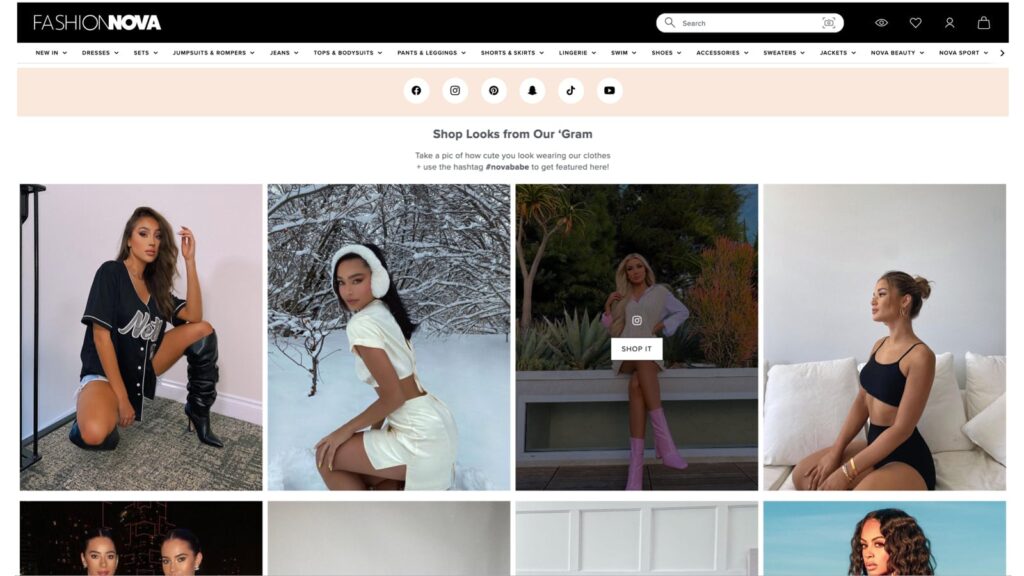
Fashion Nova’s success is based on tracking the engagement rate of Instagram users, which allows the company to identify current trends and the audience’s preferences. The company quickly creates affordable versions of popular looks it sees on influencers. Fashion Nova then enlists those same influencers to promote its products, creating a closed-loop cycle of influence.
A particularly interesting aspect of the strategy is the creation of the “Novababes” community—micro-influencers who regularly post photos of themselves wearing the brand’s clothing. The best photos are posted on Fashion Nova’s official page, which has 14 million followers, giving users the opportunity to quickly gain popularity.
The results are impressive—according to CEO Richard Sagian, the company grew by 600% in 2017 alone, and in 2018, Fashion Nova became the most-searched fashion brand on Google, surpassing major luxury brands.
GoPro: Million Dollar Challenge
GoPro has launched an innovative campaign called the “Million Dollar Challenge,” which is entirely based on user-generated content. The company is inviting owners of its cameras to shoot exciting videos and submit them to enter the contest.
Winners receive a share of the $1 million prize pool. In 2023, the campaign broke a record: 42,446 video clips were submitted, a 66% increase compared to the previous year. The final product is a three-minute video created entirely from user-generated content that showcases GoPro’s capabilities.

Interestingly, to participate in the contest, users had to use the latest camera models for UGC content—the HERO11 Black and HERO11 Black Mini—which helped boost sales of the new products. The videos were submitted by a total of 55 creators from 21 countries, each of whom received $18,181.81 for their contribution.
Over the course of five years, GoPro paid out $5 million to participants in the Million Dollar Challenge, building a strong base of loyal customers and a vast library of high-quality content for marketing purposes.
Coca-Cola: Share a Coke
The Share a Coke campaign is one of the most striking examples of the successful use of UGC. Coca-Cola replaced the logo on its bottles with popular names, encouraging consumers to find their own names or those of their friends and share photos on social media.
The strategy was aimed at teenagers and young adults who had previously viewed Coca-Cola as “their parents’ drink.” The campaign involved the creation of a special hashtag, #ShareaCoke, which became the focal point of all social media activity.
Interesting aspects of the campaign:
- Personalized packaging featuring the 250 most popular names.
- Interactive billboards where you could enter your name and see it on a virtual bottle.
- Collaborating with influencers who are popular among teenagers.
- The ability to create virtual bottles on the ShareaCoke.com website.
The results of the UGC model are:
- an 11% increase in sales;
- an 11% increase in revenue;
- a 1.6% increase in market share.
Most importantly, the campaign attracted 1.25 million new teenagers who had not previously drunk Coca-Cola. The hashtag #ShareaCoke was used 89,000 times on Twitter and 496,000 times on Instagram.
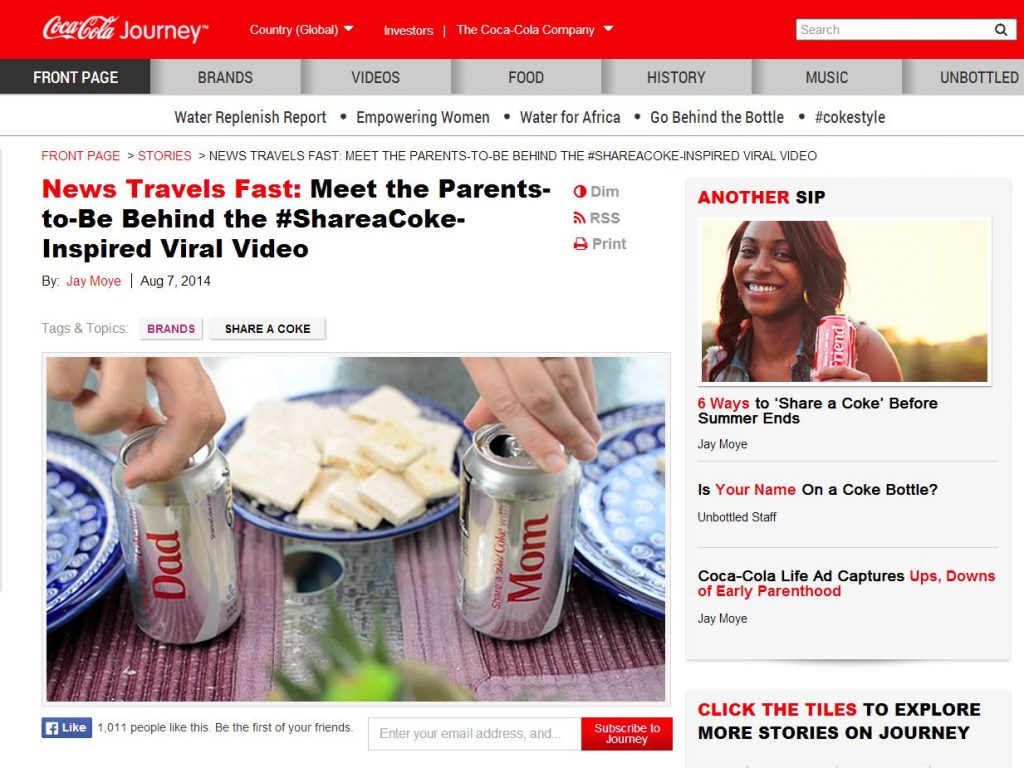
User-generated content often exceeded the company’s expectations. For example, a video by the McGillicuddy family, who announced their pregnancy using Coca-Cola cans labeled “Mom” and “Dad,” garnered 4 million views on YouTube and 50 million mentions in the media.
How to Engage Your Audience in Creating UGC Content
Successfully engaging your audience in creating UGC content requires a systematic approach and an understanding of user motivation. Here’s a step-by-step strategy to effectively encourage users to create posts:
- Set clear goals. Before launching a UGC campaign, you need to understand what the brand is trying to achieve—increasing brand awareness, attracting a new audience, boosting sales, or improving brand perception.
- Create a unique hashtag. This will help you track all posts related to the campaign. The hashtag should be easy to remember and capture the essence of your UGC initiative.
- Launch a contest or challenge. Attractive prizes motivate users to create content. Challenges with interesting tasks can go viral and significantly expand your reach.
- Integrate UGC into your product. A company can develop a product or service that naturally encourages content creation, just as Coca-Cola did with its personalized bottles or Starbucks with its festive red cups.
- Use the right platforms. The choice of social media platforms depends on the brand’s target audience. Instagram and TikTok are ideal for visual content, Twitter is ideal for short comments, and YouTube is ideal for video reviews.
- Encourage reviews. After a purchase, send customers emails asking them to share their experiences and photos of the product. Offer discounts or rewards for posting reviews with photos.
- Build a community. Creating an active community around your brand encourages a steady stream of UGC, just as Fashion Nova did with its “Novababes.”
- Engage with user-generated content. Comment on, like, and repost UGC to show your appreciation and encourage others to join in.
- Follow the legal guidelines. Always obtain permission before using user-generated content in marketing materials. Establish clear terms and conditions for participating in campaigns.
The key to success lies in understanding your audience’s motivations. People share content for various reasons: to express themselves, gain recognition, win a prize, support their favorite brand, or simply have fun. By understanding these motivations, you can develop a campaign that resonates with your target audience and encourages the creation of high-quality UGC.
How to Use UGC Content to Benefit Your Business
Collected user-generated content (UGC) is a valuable resource that must be used effectively. Effective use of UGC can significantly strengthen a brand’s marketing strategy and deliver tangible results.
Posting content on official social media pages increases audience engagement by showing that the brand values its customers. Creating a UGC gallery on the landing page allows you to showcase various ways to use the product and foster a sense of community around the company.
A few more ideas:
- creating advertising campaigns based on real customers’ stories;
- adding user reviews to email newsletters;
- the use of UGC in print materials and outdoor advertising;
- creating videos that compile the best user-generated content;
- Using UGC to educate new customers about the product’s features.
It’s important to choose the right content for promotion. Not all UGC is equally valuable—you should select content that aligns with your brand’s values, is of high quality, and showcases your product in the best light. Creating a system for moderating and categorizing user-generated content will help you manage it effectively.
Conclusion
UGC content has become an indispensable tool in modern marketing, helping brands build relationships with their audience and increase trust in their products. Successful campaigns by Fashion Nova, GoPro, and Coca-Cola demonstrate that a well-organized UGC strategy can yield amazing results for both large corporations and small businesses.
Engaging users in content creation requires a systematic approach: from clearly defining goals to implementing specific incentive mechanisms. At the same time, the use of collected UGC should be diverse and integrated into the overall marketing strategy. Our eDilo installment payment service for businesses also embraces the UGC approach to building trust with customers. We understand how important it is for companies to maintain a positive image in the eyes of consumers. That is why eDilo offers tools that help businesses not only manage their finances but also improve customer engagement by encouraging reviews and success stories. Thanks to the installment payment service, users get results they want to share—and that’s the foundation for high-quality UGC.
Актуальні
запитання
How does UGC affect brand trust and customer loyalty?
UGC content significantly boosts trust in a brand, as potential customers see real-life experiences with the product from other consumers just like themselves. Content created by real people is perceived as more honest and objective, and when a brand shares it, it demonstrates respect for the community and a willingness to listen to customers.
What tools and platforms can be used to collect UGC?
Social media platforms (Instagram, TikTok, Facebook, Twitter) are used to collect UGC, where brand mentions are tracked via hashtags. Specialized services (Yotpo, Bazaarvoice, TINT) and review platforms (Google Reviews, Trustpilot) help collect, manage, and showcase UGC across various platforms.
Can UGC content harm a brand’s reputation? If so, how can this be avoided?
UGC content can damage a brand’s reputation if negative reviews or low-quality material end up on official channels. To avoid problems, it is necessary to implement a content moderation system and develop clear guidelines for users regarding acceptable content.
Should UGC content be moderated before it is published?
Moderating UGC content before publication is essential for protecting the brand’s reputation and filtering out inappropriate material. The best approach is a combined strategy, where automated filters perform an initial check, and a human moderator makes the final decision on whether to publish.



More about business
and finance
Read more

Which Chinese Tractor Is the Best to Buy: Top 5 Models

Solar Panel Business: How to Set It Up and Calculate Liquidity

How to Choose a Business Idea in 2026: Top Ideas for Ukraine

Military Tax in Ukraine in 2025

A $5,000 Business in 2026: How to Start a Business with Minimal Risk

How to Prepare Your Business for Black Friday 2026: Purchasing Without Straining Working Capital

How to Prepare Your Business for the Fourth Quarter: A Financial Checklist for Executives

How to Avoid Stalling Business Growth Due to Large Supplier Invoices

How Businesses Can Prepare for the Peak Sales Season in Fall and Winter